


Water Dynamics vs. Rheology in LCST Polymer Solutions
download pdf fileContext
Hydrogels are soft materials composed of a polymer network swollen with water, playing a central role in applications ranging from energy storage and bioengineering to food science and cosmetics. Yet, despite water being their dominant component (typically above 90-95%), its contribution to their structure and mechanical response is still poorly understood. Within this framework, the project aims to clarify the information that solvent dynamics can provide about the gel architecture and its macroscopic rheological behavior. The overall approach relies on correlating structure (via X-ray scattering), mechanical properties (via rheometry), and solvent mobility (via low-field NMR relaxometry), enabling a multiscale understanding of how water and polymer networks interact.
Research focus
The present internship specifically investigates water dynamics in LCST-type polymer solutions based on Pluronic, a triblock copolymer composed of hydrophilic PEG blocks flanking a hydrophobic PPG core. These systems exhibit a lower critical solution temperature (LCST), above which they undergo phase separation, typically between 30 and 50 °C depending on concentration and molecular architecture.
As temperature increases, micellization and gelation alter both water mobility and the viscoelastic response of the system (Figure 1). To probe these effects, the study will combine systematic low-field NMR relaxometry with linear rheology. The key NMR observable will be
the transverse relaxation time T2, measured as a function of temperature using CPMG sequences. The project aims to highlight how NMR can uncover crucial but often neglected insights into the hydrogel structure-properties relationship.
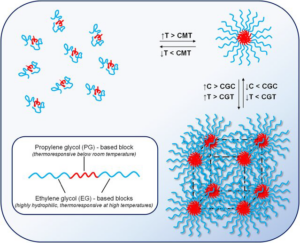
Figure 1: Micellisation and gelation of Pluronicsolutions. After Constantinou et al., Polymer International 70.10 (2021): 1433-1448.
Intern Position and Research Environment
We are seeking a highly motivated M1 or M2 student (or equivalent) with a background in polymer science, soft matter physics, or materials chemistry. The ideal candidate will show a strong enthusiasm for experimental research and solid analytical skills. Good communication abilities and an interest in collaborative work are essential, as the internship will take place within a dynamic research environment and in close interaction with multiple teams.
This internship is part of a long-term collaboration between the IMP laboratory and the LP-ENSL, extending previous work on hybrid hydrogels composed of natural polymers and inorganic nanoparticles.
The internship is based in Saint-´Etienne, within the new laboratory facilities of the Campus Manufactures at IMP–UJM, where the student will be fully integrated into a dynamic research environment. Frequent visits will be made to IMP Lyon (INSA–La Doua campus) to perform low-field NMR measurements and X-ray scattering experiments, which are central to the project. Strong interactions with LP-ENSL are also expected, as part of the rheological characterization will be performed there. This internship is embedded within the broader joint research program on hydrogels between IMP-UJM and LP-ENSL. Full training on all experimental techniques will be provided from the very beginning.
The internship is expected to start in spring 2026 for either 3 or 6 months. Supervision will be ensured on a regular basis by a dedicated postdoctoral researcher, with close interactions with two senior staff researchers.
Contacts
- Dr Baptiste Robbiani
Laboratoire IMP, Université Jean Monnet
baptiste.robbiani@univ-st-etienne.fr - Pr Guilhem Baeza
Laboratoire IMP, Université Jean Monnet
guilhem.baeza@univ-st-etienne.fr - Dr Thibaut Divoux
Laboratoire LP-ENSL, École Normale Supérieure de Lyon
thibaut.divoux@ens-lyon.fr