


Probing biomass nanorods dielectric properties
Fichier pdf à téléchargerContexte
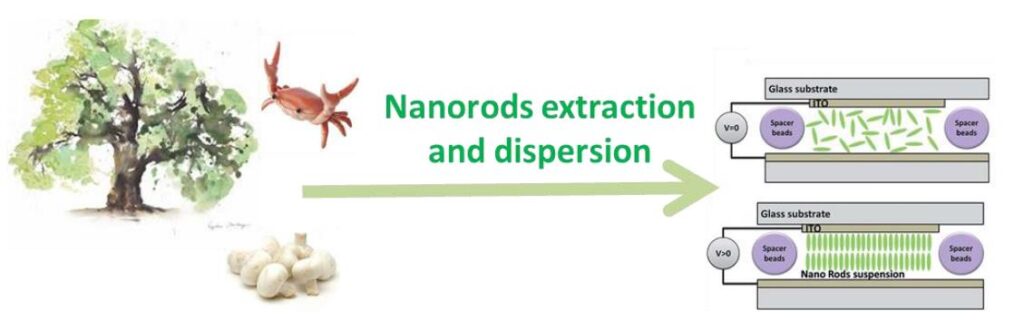
Designing smart materials which can sense, actuate or harvest energy is a critical goal to address the current technological and environmental challenges. Cellulose and chitin are biosynthesized in the form of crystalline nanorods in numerous organisms (plant, algae,
fungi, arthropod), constituting thus the most abundant biomass on Earth. Yet, their specific polar non centrosymmetric crystalline structure shall also provide them interesting dielectric properties which have been under-investigated, even if recently the presence of a giant electric dipole and of a tensile piezoelectricity were reported. [1-2]
[1] Frka-Petesic, B., Jean, B., & Heux, L. (2014). First experimental evidence of a giant permanent electric-dipole moment in cellulose nanocrystals. Europhysics Letters, 107(2), 28006.
[2] Barlemont, S., Burg, A., Serghei, A., Capsal, J. F., & Fumagalli, M. (2023). Macroscopic tensile piezoelectricity characterization of β-chitin in tubeworm tissues. Cellulose, 30(13), 8451-8458.
But
Evaluation of the relaxation and structuration of biomass nanorods colloidal suspensions in apolar solvents under an electrical field, and investigation of the influence of the nanoparticule structure on it.
Méthodologie
Preparation of cellulose nanocrystals from varying biological source (coton, tunicate, green algae) and redispersion in apolar solvents (electron microscopy, X ray diffraction, dynamic light scattering). Characterization of the resulting suspensions by broadband dielectric spectroscopy.
Profil du candidat
We are looking for a student with a strong interest for experimental work, and a background in polymer materials. Additional skills in electrical measurements will be particularly valued.
Personnes à contacter & informations
Internship for at least 6 months which can start as early as January 2025.
To apply please send your CV, a motivation letter and the contact of a reference person to Anatoli Serghei anatoli.serghei@univ-lyon1.fr and Matthieu Fumagalli matthieu.fumagalli@univ-lyon1.fr.